Hibiya Park: Unintended Consequences
Within the developing city of Tokyo, Hibiya also occupied a prominent and impressive locality. The name Hibiya comes from the name for one of the major gates to the Tokugawa shogun’s castle, the remains of which is still evident in the eastern corner of the park to this day.[1] In addition to the remnants of the gate and the wall surrounding the castle, the moat surrounding the castle was reinvented to serve as a pond for the new park. This represents the location-based incorporation of the old into the design of the park. However, many newer and more western influences were also present given the parks proximity to the new home of the Meiji emperor. Furthermore, the park was directly across the street from the Rokumeikan, which was designed by a foreign architect, Josiah Carter, and completed in 1883 to serve as a complex to welcome foreign dignitaries.[2] The Rokumeikan served its purpose well on its own with some minor criticism, but was magnified when Hibiya Park was completed and created a neighborhood of western-style design.
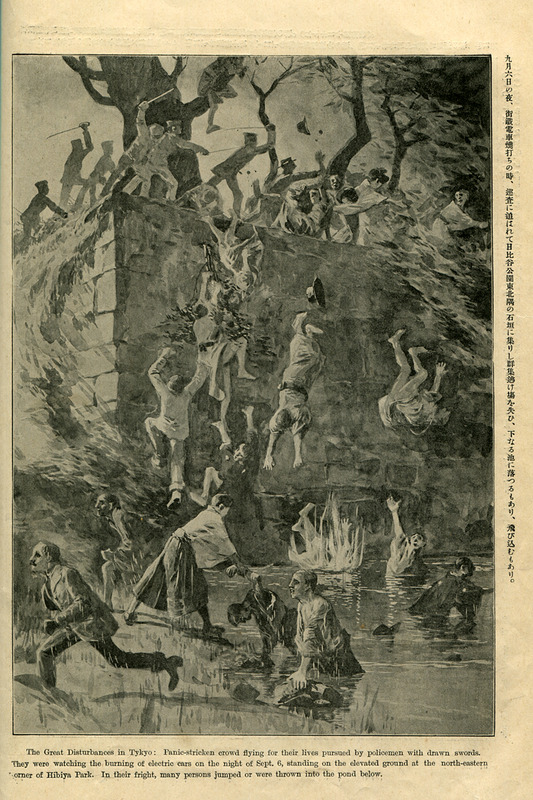
Hibiya Park did not end up serving as a home only for visiting dignitaries and well-behaved citizens, as the government may have preferred. Indeed, the park quickly devolved into a popular place for riots and protests beginning in 1905 at the conclusion of the Russo-Japanese War.[3] The people who came to protest were discontented with the conditions under which the war had been concluded, and hoped to secure a more honorable and beneficial treaty from Russia. Thirty thousand people in all showed up for the first protest in the park, which then proceeded to last for only thirty minutes. The accompanying image shows Tokyo citizens scaling the old portion of the Hibiya gate during their brief riot in 1905. Many more public protests in Tokyo followed this one between 1905 in 1918.[4] The issues surrounding each protest varied greatly, but a majority took place in Hibiya Park. Hibiya Park was not only a convenient place for a large crowd to gather, but also a simple of the vast changes in industrialization, urbanization, and westernization that Japan was experiencing.